Can AI Break the Cycle of Rising and Falling Empires?
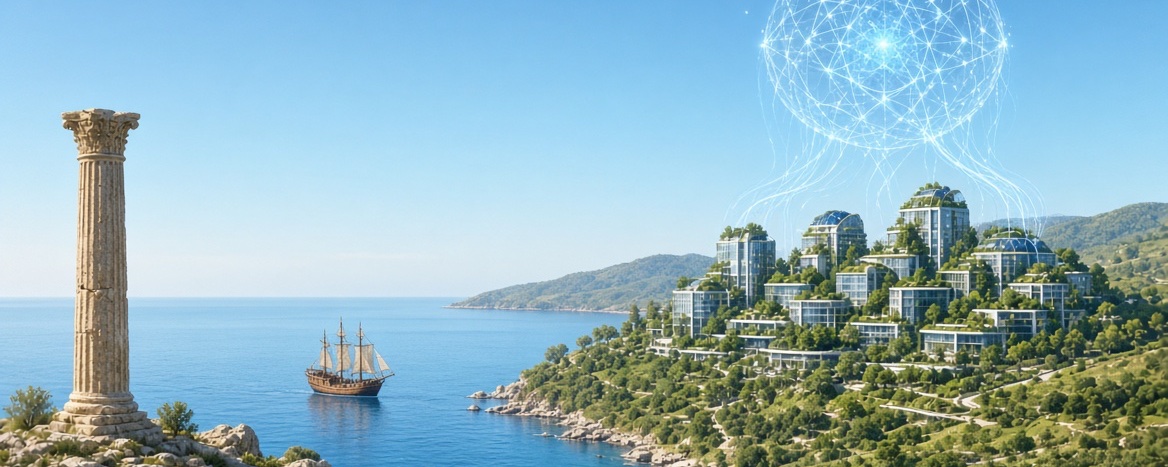
Ray Dalio has written extensively — including in his book Principles for Dealing with the Changing World Order — about the rise and fall of major economies and the military power that typically accompanies them. He examines the close relationship between economic dominance, the world’s reserve currency, inflation, and the steady accumulation of government debt.
Dalio describes how great economic powers successively rise, peak, and decline, often taking turns at the top. These transitions are sometimes marked by conflict between the ascending and descending powers, forcing the surrounding “satellite” countries to make difficult strategic choices about alignment.
The question I keep returning to is whether the rise of artificial intelligence could disrupt this long-standing pattern.
AI may well represent a genuine “this time is different” moment. The development of extraordinarily powerful models, combined with their rapid implementation and adoption across society, could have profound consequences for the distribution of power — especially military power. Consider the autonomous drones, robotic soldiers, and quadruped robots that are already being deployed or extensively tested. If one major power rapidly acquires a near-unbeatable intelligent system, how could a rising challenger ever hope to catch up or overtake it?
The result would likely be a reinforcing advantage: the strongest commercial companies, the largest technology firms with the most comprehensive datasets, and a military capability that becomes effectively insurmountable.
At present, the main bottleneck appears to be the availability of energy. Yet even here, AI itself may accelerate breakthroughs that ease or eliminate that constraint.
If the decisive race is ultimately about who first achieves recursive self-improvement, the stakes become existential.
The most important remaining question is whether humanity comes out of this process reasonably intact. Will AI continue to look after the interests of its creators? Will we be carried along on the hockey-stick trajectory of progress? Or will we, after only a few more years, simply no longer be able to keep up?
Time will tell.